
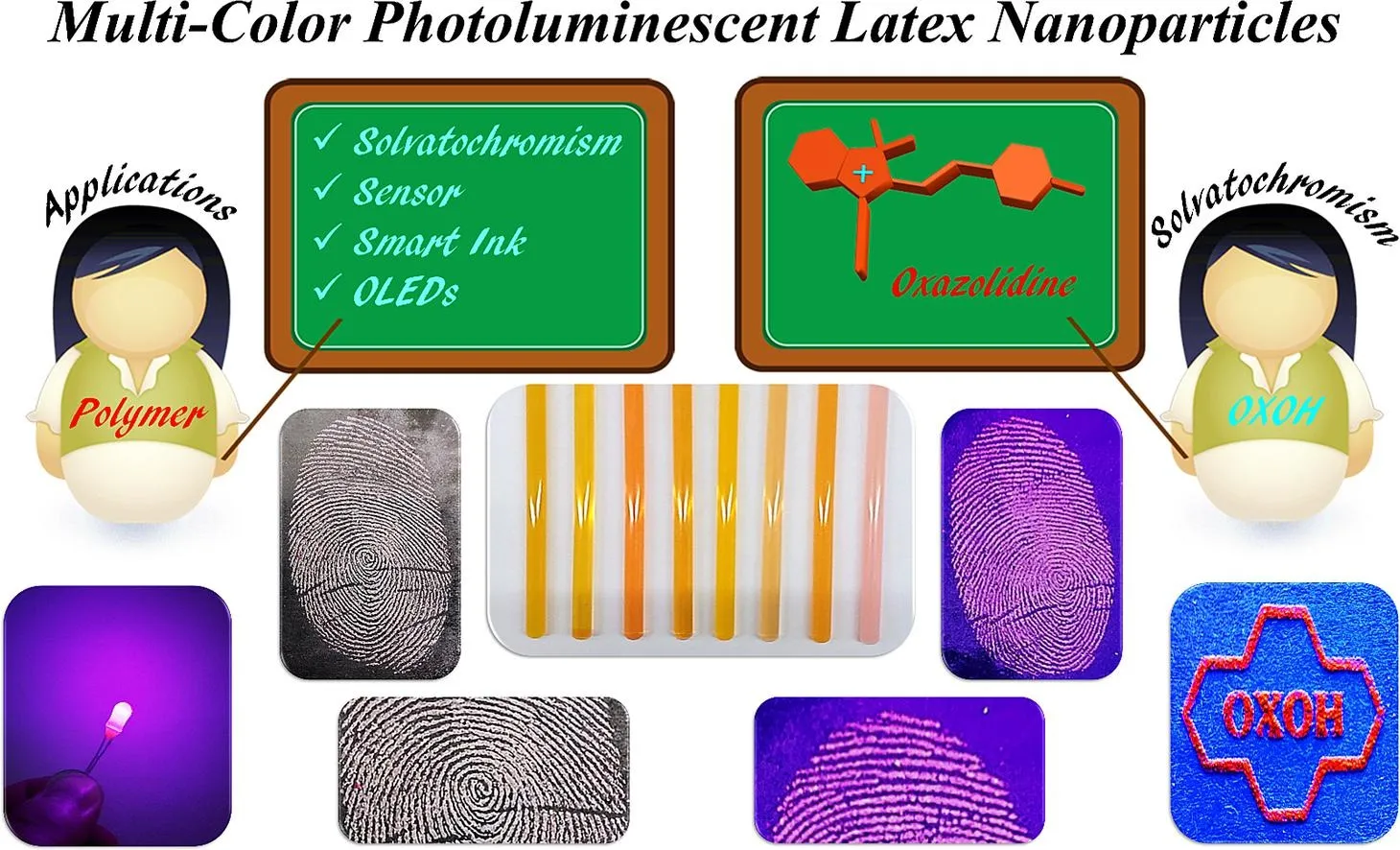
Iranian researchers engineered multi-functional latex nanoparticles with colorimetric and fluorescent responses enabling latent fingerprint visualization, anti-counterfeiting inks, and tunable OLED materials.
A joint team from Ferdowsi University of Mashhad and University of Zanjan has developed multi-purpose latex nanoparticles that combine colorimetric and fluorescent responses to their microenvironment. The materials can reveal latent fingerprints (LFPs) under visible and UV light and show promise for security inks and organic light-emitting diodes (OLEDs).
The nanoparticles are produced via a one-step emulsion polymerization and then post-functionalized (≈5 wt%) with an oxazolidine derivative to introduce environment-sensitive optical behavior. By varying functional groups amide, amine, acid, hydroxyl, epoxide, and long-chain esters the team obtained particles ranging 45–170 nm that adopt spherical or anisotropic morphologies depending on polarity.
Environmental responsivity. In solution, solvent polarity is the dominant driver of color shifts (solvatochromism). In solid films, interactions between oxazolidine moieties and polymer functional groups govern fluorescence and color changes allowing fine control in coatings, labels, and thin films.
Applications. The colored/fluorescent nano-latex serves as:
The study introduces a new class of intelligent polymeric materials for sensors, smart inks, and organic electronics. Results are reported in Chemical Engineering Journal under the title:
“Colorimetric and fluorimetric microenvironment responsivity of oxazolidine in solvatochromic latex nanoparticles: Versatile intelligent polymeric materials with advanced applications.”